Fast-Acting Hemp Drinks: How Nano-Emulsification Actually Works (and Why It Hits in 15 Minutes)

Ship to
Fast-acting hemp drinks are blowing up because they answer one simple consumer demand: don’t make me wait an hour to feel something.
And yet the #1 question buyers ask is painfully consistent: Why do these hit faster than gummies or brownies? Fair question. Traditional edibles have the urgency of a postcard. Fast-acting drinks move more like a text message.
Let’s break down what’s actually happening, why nano-emulsification matters, what “15 minutes” really means, how long the effects last, what to look for on a label, and the one regulatory detail that can sneak up on brands and shoppers alike.
Here’s the core issue: THC is lipophilic, meaning it loves fat and hates water. Your body is mostly water. Your digestive tract is watery. Your bloodstream is watery. So when you swallow THC in a traditional edible, your body has to do extra work to absorb it.
Even when a gummy is perfectly dosed, oral THC bioavailability is typically low, roughly 4% to 20% depending on formulation, your metabolism, whether you ate food, and the alignment of the cosmos.
That low bioavailability creates three classic edible complaints:
Fast-acting hemp drinks exist because the market got tired of roulette.
When you eat a conventional edible, most of the THC has to go through first-pass metabolism in the liver. That’s a big reason onset is delayed and effects can feel heavier.
A simplified version of the route looks like this:
This process is slow. It’s also variable. Your stomach contents, digestive speed, liver enzyme activity, and what else you consumed all influence the timeline.
That’s why the typical onset range for classic edibles is often 45 to 90 minutes, and sometimes longer.
Fast-acting drinks are engineered to sidestep as much of that slow lane as possible.
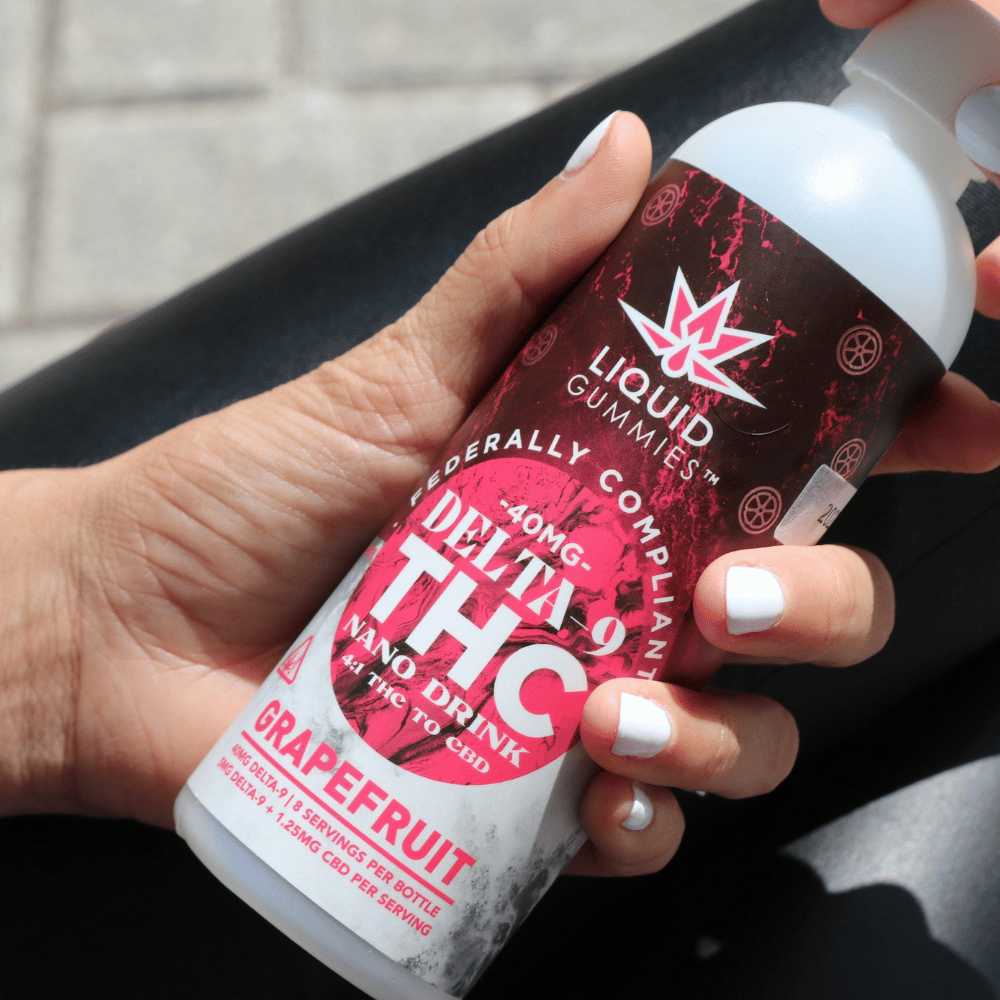
Most fast-acting hemp drinks rely on some version of nano-emulsification.
An emulsion is simply oil droplets dispersed in water. Think salad dressing, but engineered so it doesn’t separate, doesn’t look oily, and doesn’t depend on you shaking it like a maraca.
“Nano” refers to droplet size. Not “a little smaller.” More like “so much smaller it behaves differently in the body.”
Nano-emulsification breaks cannabinoid oil into extremely tiny droplets and stabilizes them with emulsifiers (often food-grade surfactants). The result is a THC dispersion that can mix into a water-based beverage and stay evenly distributed.
Why does that matter?
Because smaller droplets have more surface area relative to their volume. More surface area means more contact with the watery environment of your digestive tract and mucous membranes, which generally means:
It’s the same THC, but in a delivery format your body can handle faster. Like showing up to the airport with TSA PreCheck instead of unpacking your entire suitcase in public.
You’ll often see labels say “water soluble.” Strictly speaking, THC doesn’t magically become truly water-soluble in the chemistry textbook sense. What’s usually happening is water-dispersible THC via emulsification.
Still, from a consumer standpoint, that label can be helpful. It usually signals a formulation designed for quicker, more predictable effects compared to old-school edibles.
Fast-acting drinks commonly claim onset around 15 minutes, especially compared to the 45–90 minutes typical of traditional edibles.
That faster onset is generally attributed to two things:
Important: not every “fast-acting” drink is equal. Particle size, emulsifier system, stability, and beverage composition all matter. Two products can both say “nano” and behave differently.
Also important: “15 minutes” doesn’t mean “peak effects.” It usually means you start noticing effects. Many people feel a ramp-up, with a peak later.
Use this mental model:
If you’re a cautious user (you should be), this is the real advantage. You can evaluate sooner and avoid stacking doses out of impatience.
Fast onset usually comes with a trade-off: duration often feels shorter compared to classic edibles.
Many people report that fast-acting hemp drinks feel more like:
While traditional edibles can feel like:
This isn’t a universal rule, but it’s common.
Why? In general terms, faster absorption can mean the body reaches effective blood levels sooner and then clears sooner. Meanwhile, classic edibles involving heavy digestion and liver metabolism can stretch effects out longer.
If you want a more controlled, social, “I still have plans later” experience, drinks tend to match that vibe. If you want an all-evening commitment, traditional edibles may last longer.
Let’s come back to the number that matters: oral THC bioavailability often sits around 4% to 20%.
That range is a big deal. It explains why the same nominal dose can feel wildly different:
Nano-emulsified beverages aim to improve consistency and absorption efficiency by making THC easier to disperse and absorb. Some formulations may substantially improve functional uptake compared to conventional oil-based edibles.
But keep your head on straight: you won’t always see exact bioavailability numbers on a label, and brands rarely publish robust human pharmacokinetic data for every SKU. Judge products by your experience, start low, and stick with brands that show serious testing and transparent formulation language.
If you want a drink that actually behaves like a fast-acting drink, stop guessing. Read the label like you mean it.
Look for keywords such as:
Also check for practical details that separate real products from pretty cans:
Don’t settle for ambiguity. If it’s 10mg per can, the label should say that clearly. If it’s 2 servings of 5mg each, it should say that too.
If the serving is “one sip” and the can is 10mg, that’s not a serving size. That’s a legal bedtime story.
You want a product that can back up its cannabinoid content and confirm it’s compliant. Bonus points if the COA is easy to find via QR code and not buried like a cursed artifact.
Some brands mention “nano,” but the drink still separates, tastes oily, or hits like a standard edible. Those are clues. A stable, consistent beverage experience usually tracks with better emulsification work.
Fast onset is great. Fast regret is not.
Follow this protocol:
If you’re using it socially, treat it like a beer substitute with a slightly different engine. Sip. Pause. Reassess. Repeat.
This category isn’t growing because it’s trendy. It’s growing because it solves problems:
It also helps that hemp THC beverages, where compliant, often fit into retail channels more easily than traditional cannabis products in many markets. That’s part of why you’re seeing mainstream placement.
Now the unsexy but critical part: regulations are shifting, and some states are pushing or implementing caps like 5mg THC per serving for hemp-derived THC products.
This matters for two reasons:
Do not assume your state treats these products the same way as another state. Do not assume what was compliant last month is compliant next month. Check your local rules and retailer guidance, and read labels carefully.
Fast-acting hemp drinks aren’t magic. They’re formulation.
They work because nano-emulsification breaks THC oil into tiny, stable droplets that disperse in water and generally absorb faster and more consistently than traditional edible formats. That’s why many users feel onset in about 15 minutes, compared with 45–90 minutes for classic edibles. It’s also why the experience often feels more controllable and, for many people, shorter in duration.
So do this:
You wanted an answer to “why it hits faster than edibles.” Now you’ve got it. Sip accordingly.
Fast-acting hemp THC drinks hit faster because they use nano-emulsification technology, which breaks THC oil into extremely tiny droplets that disperse evenly in water. This increases surface area for absorption, allowing the body to absorb THC more quickly compared to traditional edibles that rely on slow digestion and first-pass metabolism in the liver.
Nano-emulsification is a process that breaks down cannabinoid oils into tiny droplets stabilized with emulsifiers, enabling them to mix uniformly in water-based drinks. This technique enhances the bioavailability of THC by improving dispersion and absorption speed, resulting in faster and more predictable effects compared to conventional edibles.
Fast-acting hemp drinks commonly claim an onset time of around 15 minutes. This quicker effect is due to smaller particle size from nano-emulsification and potential early absorption through tissues in the mouth if the drink is sipped and held briefly, bypassing some of the slower digestive processes.
Traditional edibles have slow onset times (often 45–90 minutes) because THC is lipophilic and must be metabolized through the digestive system and liver (first-pass metabolism), which slows absorption. Factors like stomach contents, metabolism, and liver enzyme activity cause variability, leading to unpredictable effects and longer durations.
'Water-soluble' on labels usually refers to 'water-dispersible' THC achieved via nano-emulsification rather than true chemical water solubility. This means THC oil droplets are finely dispersed in water, enhancing absorption speed and consistency, but chemically, THC remains lipophilic (oil-loving) rather than fully soluble in water.
Consumers should look for terms like 'nano-emulsified' or 'water-dispersible,' which indicate advanced formulation techniques for faster absorption. Additionally, checking dosage information, ingredient lists for food-grade emulsifiers, and verifying compliance with local regulations can help ensure safety and effectiveness.

Jun 22, 2026 Jenna Renz

Jun 22, 2026 Jenna Renz

Jun 22, 2026 Jenna Renz